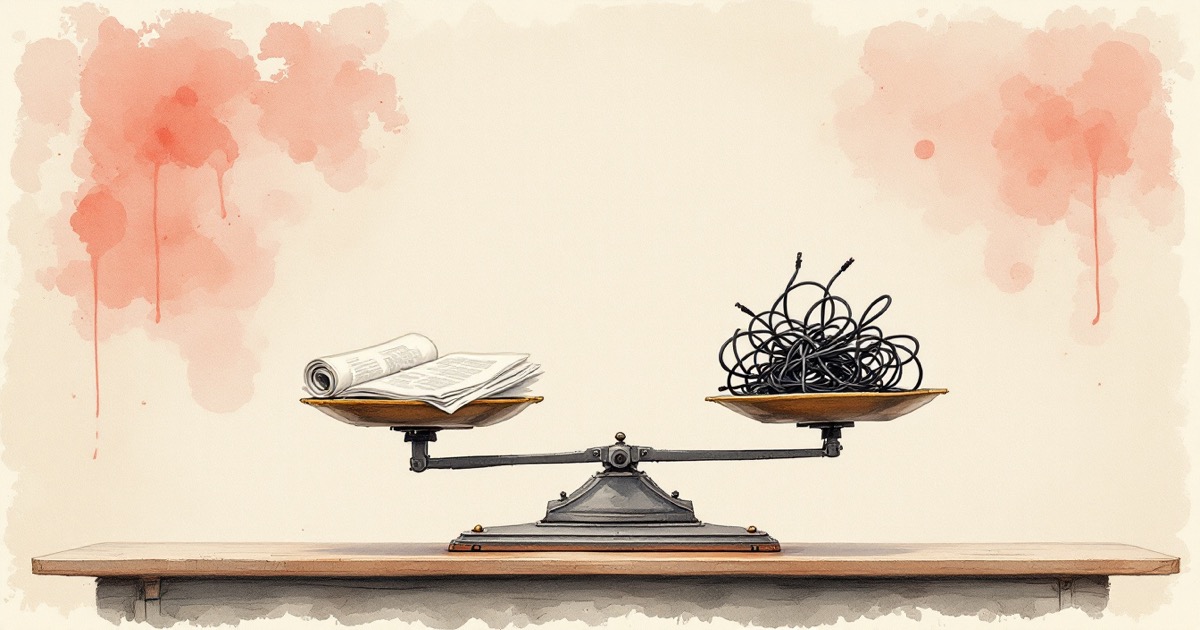
Curated news is news selected by human editors who decide what’s important enough to show you — a newspaper front page, a daily email digest, an edited briefing. Algorithmic news is news ranked by software that predicts what will keep you engaged. Almost everything you read arrives through one of these two filters, and they fail in opposite ways.
When people talk about alternatives to doomscrolling, they usually land on one of two answers: get a curated newsletter, or get a smarter algorithm.
Both are presented as solutions to the same problem — too much noise, too much anxiety, too much time on screen. But they’re very different things, and understanding the difference helps you make a better choice about how you consume news.
What algorithmic news is
An algorithmic news feed is one where a machine decides what you see, in what order, based on signals about what keeps you engaged.
The signals vary by platform. Apple News factors in reading time, tap-throughs, and topic preferences you’ve indicated. Google News uses your search history, location, and behavior across Google’s properties. Twitter/X surfaces content based on likes, follows, and what’s trending in your network. Every major tech-platform news product is, at its core, an engagement-optimization system.
The goal of the algorithm is not to inform you. It’s to keep you in the app. Those two goals are different, and when they conflict, engagement wins.
This is not speculation — it’s what the engineers building these systems have said publicly. Facebook’s own internal research showed that their algorithm amplified content that provoked strong reactions, including anger, because anger drove engagement. The reaction to this research was not to change the algorithm. It was to dispute whether the research was conclusive.
Engagement-optimized feeds have a structural problem: the most informative stories are rarely the most emotionally activating ones. A measured explanation of an economic policy is important and boring. A clip of a politician saying something inflammatory is unimportant and riveting. The algorithm will surface the clip.
What curated news is
A curated news product is one where humans decide what you see. Editors read the news, decide what’s important, write it up or select it, and hand it to you.
This is the oldest model in journalism. Every newspaper has always been curated — the front page is a curation decision, the story selection is a curation decision, the placement of stories is a curation decision.
Modern curated products include daily email newsletters like 1440, human-edited digests like Axios newsletters, and slower editorial products like Slow News Co. In each case, a team of people is making explicit choices about what to include, what to exclude, and how much space to give each story.
Curation has real advantages: a thoughtful editor adds genuine value, and a finite newsletter ends. You’re not pulled into an endless feed.
But curation is not neutral either.
The limits of curation
Every curation decision reflects a set of values, assumptions, and blind spots. When an editor decides that story A is more important than story B, they are expressing a judgment that is not universal. Different reasonable people would curate differently.
This is fine — it’s just a different kind of editorial influence than the algorithm’s. The algorithm promotes what’s engaging. The editor promotes what they think is important. Neither is the unmediated truth about what you should know.
There’s also a personalization problem. A curated newsletter covers what the editor thinks is broadly important. If you care deeply about climate policy and don’t care at all about sports, you’ll get light coverage of climate and some sports coverage anyway. Curation is built for an imagined average reader, not for you specifically.
The third option: personalized neutral delivery
There’s a third model that’s newer and less well understood: AI-clustered, topic-personalized, neutral delivery.
In this model, you specify your topics. An AI system monitors every source covering those topics, identifies when multiple outlets are covering the same underlying event, groups those stories into a single cluster, and generates one neutral summary of the event from the full range of coverage.
This is different from both algorithmic and curated news:
- Unlike algorithmic news, it’s not optimized for engagement. The ranking is chronological — what happened most recently — not what will keep you scrolling.
- Unlike curated news, it’s personalized to your actual interests, not to an imagined average reader. And it doesn’t reflect a human editorial team’s values about what’s important.
- Unlike both, it actively deduplicates. Instead of seeing ten versions of the same story, you see one summary that draws on all of them.
This model also addresses the outrage problem at the source level. When you summarize ten articles about an event, the emotionally charged language from the most outrage-y outlet gets averaged out against the neutral language from the wire services. The summary reflects the facts, not the editorial temperature of whichever outlet happened to cover it most angrily.
Which model is best for you?
If you want to stop doomscrolling entirely and don’t care about personalization: A curated daily newsletter (1440, Morning Brew) gives you a clean stopping point and human judgment about what’s important.
If you want to understand your news diet and media bias: An algorithmic product with transparent signals (Ground News) lets you see how different sources cover the same story.
If you want depth on topics you specifically care about, without the outrage layer: AI-clustered personalized delivery (Wisp) gives you coverage of your interests in a format that doesn’t reward engagement.
If you want a short daily magazine of interesting articles, not a briefing: Slow News Co. is a human-edited website (and Apple app) that picks a finite set of pieces from other outlets and then stops.
The worst option is the default one: a social media feed or a major tech platform’s news tab, where the algorithm has no goal except keeping you in it.
The question worth asking
Before you choose a news product, ask: what is this optimized for?
If the answer is “time on screen” or “clicks” or “engagement,” the product’s incentives are not aligned with yours. If the answer is “your satisfaction” or “your subscription renewal” or “informing you well enough that you come back tomorrow,” the incentives are closer to aligned.
Wisp is optimized for one thing: getting you informed on your topics and letting you go. No infinite scroll. No algorithmic ranking. No language designed to keep you in a state of activation.
Download Wisp on the App Store · Google Play
Related: How to Stop Doomscrolling · What Is Outrage Journalism? · How to Stay Informed Without Feeling Overwhelmed